From Local SEO to an Intelligent Business
When we began working on the digital presence of Tropical Nails & Spa in West Jordan, Utah, and Sassy Nails, the objective wasn't simply to build prettier websites.
We wanted to understand the entire path a customer takes—from searching for a nail salon on Google to becoming a repeat customer.
That meant looking at the businesses as systems.
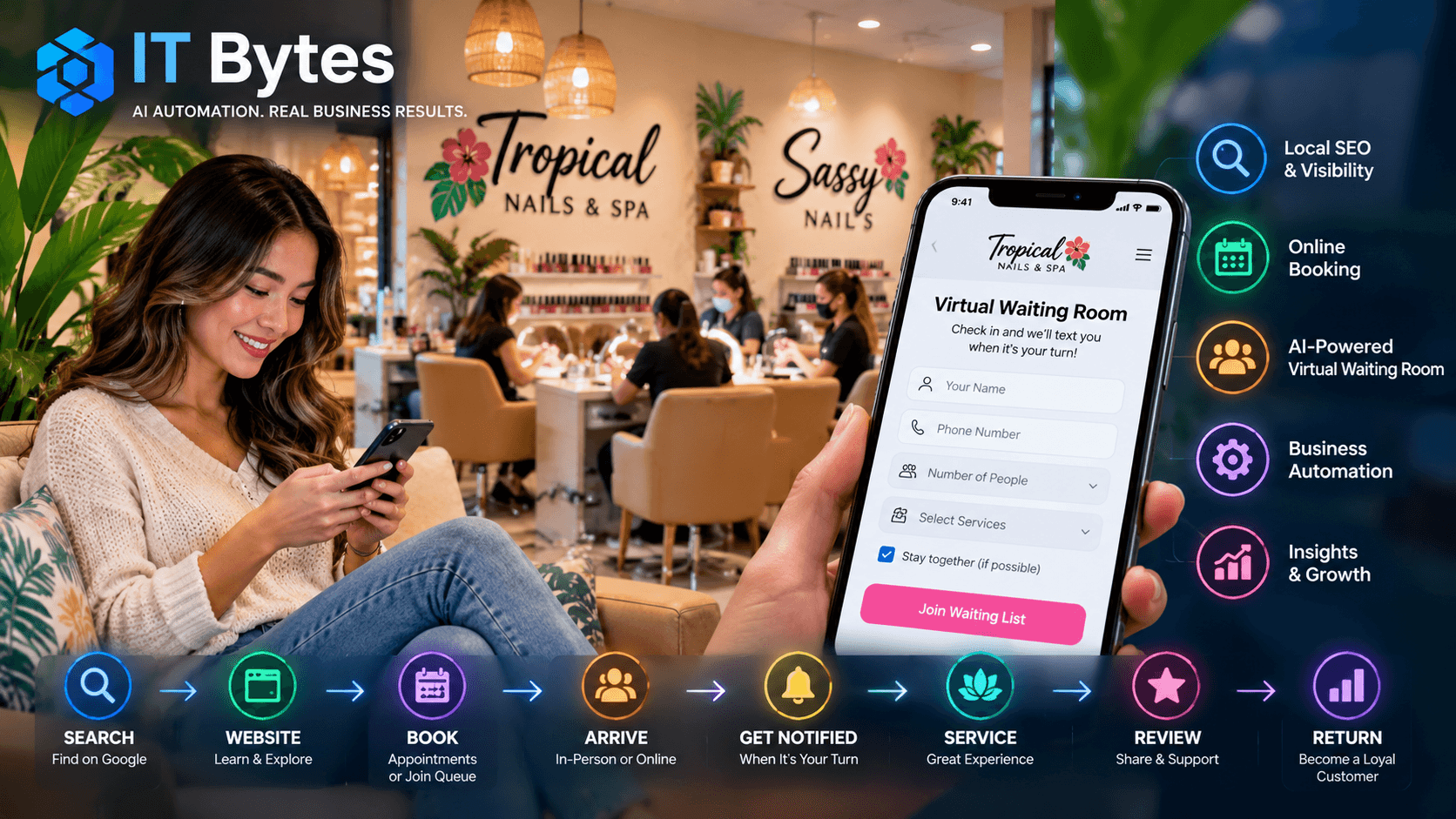
A customer might discover the salon through Google Search or Google Maps, visit the website, compare services, read reviews, book an appointment, walk through the door, receive a service, join a loyalty program, leave a review, and eventually return.
Every one of those steps creates an opportunity for technology to make the experience better.
Building the Digital Foundation First
Before introducing AI agents, we concentrated on getting the fundamentals right.
We rebuilt and optimized the salons' websites, developed service-specific pages around searches customers actually make, improved internal linking and site structure, implemented structured data, connected analytics and Google Search Console, improved Google Business Profile information, integrated online booking, and worked to make business information consistent across the web.
We also began measuring what happened after those changes.
Search visibility, impressions, clicks, website traffic, bookings, reviews, and customer behavior give us information we can use to make the next decision.
This is an important part of our approach to AI at IT Bytes:
Don't automate a broken process. Understand it first.
Then We Found a Different Problem
Improving search visibility can bring more customers to a business.
But what happens when those customers arrive?
Nail salons have an operational challenge that traditional appointment systems don't handle particularly well.
Some customers schedule appointments. Others walk in.
Services take different amounts of time. Different technicians have different capabilities. Customers may arrive individually or in groups. Groups may want to stay together. Staffing levels change throughout the day.
And during busy periods, someone may walk into a crowded lobby, assume the wait will be too long, and leave.
That led us to a simple question:
Why does the customer have to physically sit inside the salon to be in line?
Building the Virtual Waiting Room
That question became the foundation for Tropical Nails & Spa's Virtual Waiting Room.
Customers can join the waiting list digitally instead of waiting inside the salon.
They provide information such as their name, phone number, number of people in their party, and requested services.
From the customer's perspective, it should feel simple.
Behind that simple interface, however, we're building much more sophisticated logic.
The system needs to understand the salon's operating hours, current staffing, technician availability, services requested, party size, existing appointments, customers already waiting, and whether a group wants to stay together.
It then needs to determine what should happen next.
Real Businesses Don't Always Follow Simple Rules
One of the interesting lessons from building the system has been discovering how quickly seemingly simple business rules become complex.
Consider a party of four customers who want to stay together.
If only two technicians are working, a basic scheduling system could determine that four technicians will never be simultaneously available and reject the request.
But that's not how the salon actually operates.
The better decision may be to accept the party, recognize that two technicians represent the salon's current maximum capacity, and coordinate the group accordingly.
That small example illustrates something much larger about AI agents.
Traditional software asks:
Does this transaction satisfy the rule?
An intelligent agent can increasingly ask:
Given the current situation and the business's objectives, what should happen next?
Connecting Square, Data and Automation
The Virtual Waiting Room isn't intended to operate as an isolated application.
We're building it around the systems the salon already uses.
Square handles appointments and other parts of the customer experience. The waiting-room system can use appointment and availability information as part of its decision-making process. Operational data can be maintained separately, and automation can coordinate what happens between systems.
The goal is not to replace every piece of existing software.
It's to create an intelligent layer that helps those systems work together.
The Lobby Can Become Digital
The next step makes the concept even more interesting.
Imagine walking into the salon and checking in on an iPad.
You're told that there's a wait, but instead of sitting in the lobby, you're free to leave.
You can shop nearby, grab something to eat, or run another errand.
When your turn approaches, the system sends you a text message.
Meanwhile, another customer could join the same queue from their phone before arriving at the salon.
To the business, they're simply customers in the same intelligent queue.
The distinction between the physical waiting room and the digital waiting room begins to disappear.
AI Should Solve Real Problems
There is enormous attention around artificial intelligence right now, but small businesses don't necessarily need another AI demonstration.
They need solutions to everyday problems.
They need more customers to find them.
They need easier booking.
They need fewer missed opportunities.
They need employees spending less time answering repetitive questions.
They need customers to know when it's their turn.
They need better information about what's happening inside their business.
And they need technology that doesn't require another full-time employee to operate it.
That's where we believe AI agents become particularly valuable.
Humans Stay in Control
We're also deliberately designing these systems around the people operating the business.
Automation shouldn't mean removing human judgment from every decision.
There will always be unusual situations—a customer with a special request, an employee running behind, an unexpected staffing change, or simply a manager who knows something the software doesn't.
The system should help the employees make better decisions and automate routine ones while still giving the business control when circumstances require it.
That's an important distinction.
The goal isn't to replace the people running the business. It's to give them better tools.
Creating the Small-Business Intelligence Layer
What started as SEO work is gradually becoming something much larger.
We're beginning to connect the entire customer lifecycle:
Search → Website → Booking → Arrival → Queue → Notification → Service → Loyalty → Review → Return
Each stage generates information.
Each stage can communicate with another.
And increasingly, intelligent agents can help coordinate what happens between them.
Instead of thinking about AI as a standalone product, we're thinking about it as an intelligence layer that can sit across the business.
A Real-World Laboratory for IT Bytes
For IT Bytes, this project is particularly valuable because it isn't a demonstration built around imaginary data.
These are operating businesses serving real customers.
That means we can build something, deploy it, watch what happens, identify where it fails, improve it, and measure the results.
As the Virtual Waiting Room moves into real-world use, we'll be watching metrics such as adoption, wait times, customer behavior, bookings, search visibility and operational efficiency.
Those results will influence what we build next.
From Enterprise Systems to Small-Business AI
My background is in designing and implementing enterprise technology systems.
One lesson carries directly from enterprise infrastructure into AI:
The individual technology matters less than how the entire system works together.
A website by itself isn't the solution.
SEO by itself isn't the solution.
An appointment platform isn't the solution.
An AI agent isn't the solution.
The real opportunity comes from connecting them.
That's what we're building at IT Bytes: practical systems that combine existing technology, automation, data and AI to solve real business problems.
And sometimes the best place to demonstrate what the future of AI-enabled business looks like isn't inside a massive technology company.
It's inside a neighborhood nail salon.