A major merger can expose every inconsistency that accumulated independently across two enterprise environments. Backup operations are no exception. Different naming standards, overlapping schedules, one-off jobs, varied retention policies, and competing infrastructure dependencies can quickly become operational risk when the environments must be managed as one.
IT Bytes provided senior engineering support to a large global enterprise as its backup and recovery environment expanded through a merger. The work centered on making protection easier to govern, more scalable to operate, and less disruptive to production workloads.
Confidentiality note: The organization and identifying implementation details have been intentionally omitted. This case study describes the engineering challenges, approach, and directional outcomes without disclosing confidential information.
The challenge: growth amplified backup-job sprawl
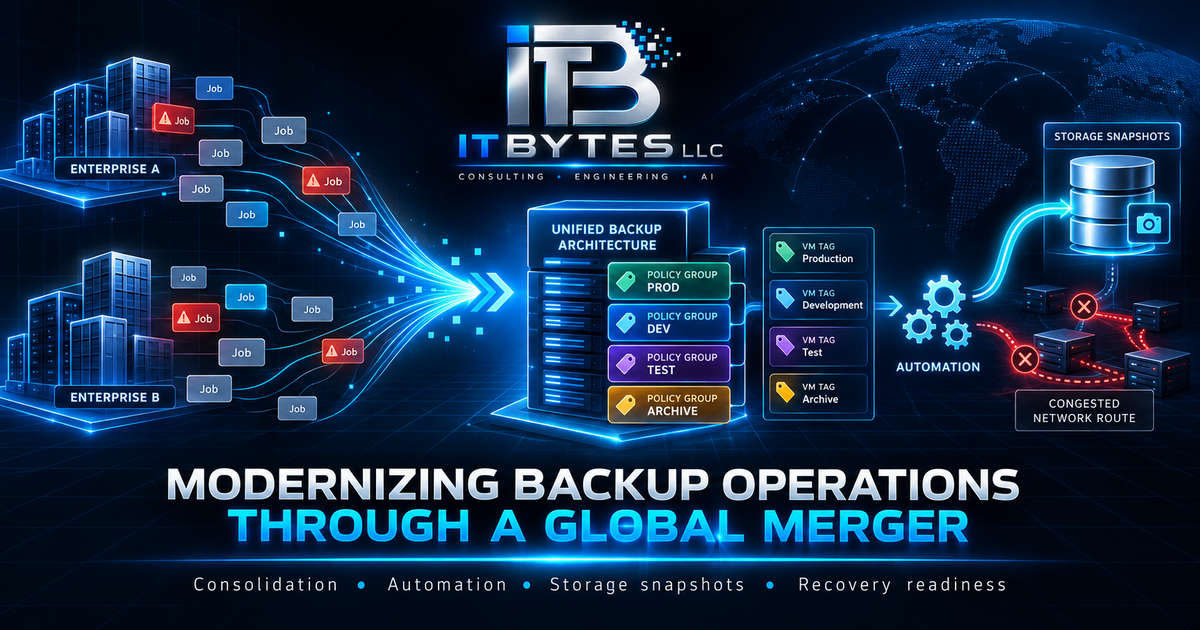
Over time, application and infrastructure teams had created backup jobs around immediate requirements. That approach protected workloads, but it also produced a growing number of jobs with different schedules, scopes, and operational histories. During a merger, that job sprawl becomes harder to monitor and easier to misconfigure.
The combined environment also had to account for increasing data volumes, constrained backup windows, SQL workloads sensitive to snapshot activity, and network-based data movement that could place unnecessary demand on production paths. Simply duplicating the existing model at a larger scale would have carried its limitations forward.
1. Consolidating jobs into a manageable protection model
The first priority was to evaluate existing jobs, identify overlapping requirements, and consolidate protection where it made operational sense. Fewer, better-organized jobs reduced scheduling complexity and made policy intent easier to understand.
Consolidation was not treated as an exercise in reaching the smallest possible job count. Workloads with different recovery requirements, application behavior, or operational constraints still needed appropriate separation. The goal was a structure operators could maintain as the environment changed.
2. Automating protection with VMware tags
Static lists of virtual machines create administrative drag in a changing enterprise. New workloads can be missed, retired systems can linger, and migrations require repeated job edits. VMware tag-based selection helped move protection closer to a policy-driven model.
When virtualization teams applied approved tags, workloads could be associated with the appropriate protection scope without manually editing multiple backup jobs. This created a cleaner handoff between provisioning and data protection while reducing the risk of unprotected virtual machines caused by ordinary environmental change.
3. Moving data through storage snapshots
Traditional network-based backup flows can add traffic to production networks and extend backup windows as data volumes grow. The modernization effort included increasing the use of storage-snapshot integration so eligible backup data could be processed through a more efficient path.
This helped reduce dependence on the production network for bulk backup movement and allowed the architecture to make better use of the enterprise storage platform. It also required coordination across backup, virtualization, storage, and application teams; changing the data path without validating the complete workflow can simply move a bottleneck elsewhere.
4. Reducing SQL disruption and missed windows
SQL workloads can be sensitive to snapshot creation, consolidation, and prolonged processing. Excessive virtual machine stun can affect application availability, while jobs that overrun their window can collide with business activity or the next protection cycle.
The work included reviewing job composition, schedules, processing behavior, snapshot duration, infrastructure dependencies, and the paths used to move backup data. Improving job design and the surrounding processes reduced avoidable pressure on SQL workloads and improved the likelihood that backups completed within their intended windows.
No single setting solved the issue. The improvement came from treating SQL protection as an end-to-end workflow across the application, VMware, storage, network, and backup layers.
5. Improving the operating process
Architecture changes are only durable when the operating model changes with them. Standards were strengthened around job organization, tagging, workload onboarding, scheduling, monitoring, exception handling, and documentation. These processes made it easier to understand why a workload was protected a certain way and how to respond when conditions changed.
The directional results
- A more organized backup-job structure with less unnecessary sprawl.
- Policy-driven workload inclusion using VMware tags.
- Greater use of storage-snapshot integration instead of relying solely on network-based backup flows.
- Reduced operational risk from long snapshot activity and SQL workload disruption.
- More reliable backup-window execution through coordinated architecture and process improvements.
- A more scalable foundation for operating the combined global environment.
The lesson: merger integration is an opportunity to redesign
It is tempting to approach a merger by connecting two existing environments and preserving every established process. That may reduce short-term change, but it can also preserve duplicated jobs, inconsistent policies, inefficient data paths, and fragile operational knowledge.
The better approach is to identify the principles the combined environment should follow, then use consolidation and automation to move toward them. In backup and recovery, the result should not merely be a larger platform. It should be an environment that is easier to protect, operate, test, and recover.
IT Bytes LLC
Managing backup growth, consolidation, or modernization?
Scott Hunt provides senior Veeam and enterprise infrastructure engineering across architecture, optimization, automation, storage integration, recovery workflows, and operational standards.